The hidden but important world of aquatic fungi
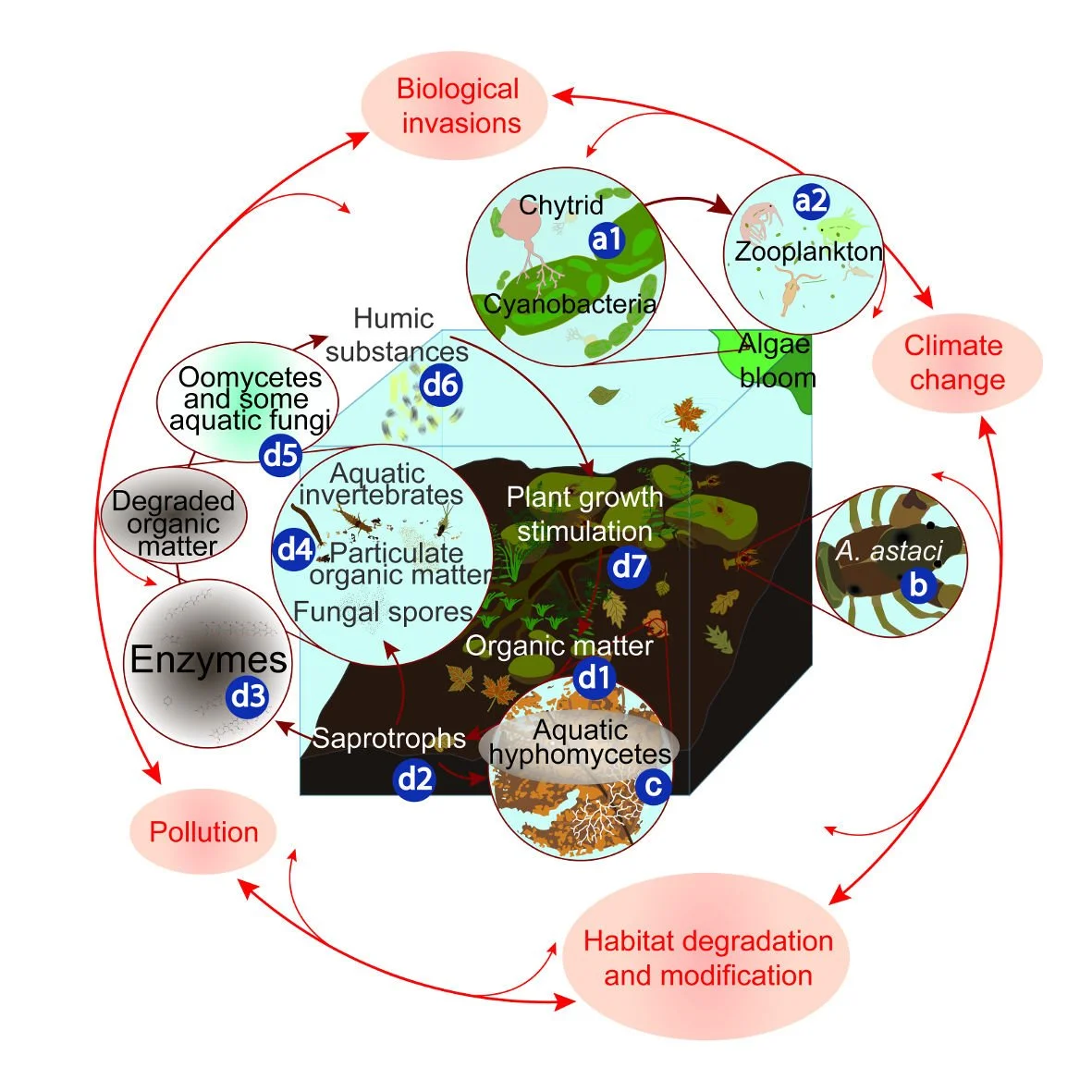
A new AFL publication highlights the importance of aquatic fungi. They are always there, dwelling in the water, where they play a key role in food webs, in cycling of nutrients, matter and energy, and water purification. However, as happens with organisms that tend to be inconspicuous and often invisible to the naked eye, society mostly neglects them, and forgets their huge importance in providing support and stability of aquatic ecosystems. What is even more problematic, we also forget that they are exposed to a wide range of threats from human activities. Without proper conservation measures, their populations can decline and go extinct just like all of the other, more conspicuous aquatic organisms, with unforeseen consequences for marine and freshwater ecosystems. This was the object of a study by an international team led by researchers from the Biology Centre of the Czech Academy of Sciences, as well as from the Leibniz Institute of Freshwater Ecology and Inland Fisheries (IGB) in Germany, and the University of Coimbra in Portugal.


Join us on 31 October at 3pm GMT (9am CST, 4pm CET) to learn more about the ambitious plans to conserve and protect Mexican goodeids. There will be talks from seven speakers, a panel discussion, and time at the end for audience Q&As.

Call for abstracts for the session (GOV_13.5) Towards Global Policy Implementation for Freshwater Biodiversity at the World Biodiversity Forum in Davos, Switzerland 16-21 June 2024 is now open and ends at 19th of November 2023, 6pm CET.

The publication showcases an Emergency Recovery Plan for bending the curve of freshwater biodiversity decline.


Call for abstracts for the international conference on protecting and restoring free-flowing rivers in Europe
